

Bradycardia in septic patients as an early sign of fungal bloodstream infection: a case series
Mohamad Abdelmonem Omar1
 , Hesham Kewan1, Hussein Kandeel1, Mahmod Makhlof1, Anand Kotgire1, Shayan Ahmed2, Syed Urooj1
Contributions: (I) Conception and design: MA Omar; (II) Administrative support: None; (III) Provision of study materials or patients: MA Omar, H Kewan, H Kandeel; (IV) Collection and assembly of data: MA Omar, M Makhlof, A Kotgire; (V) Data analysis and interpretation: MA Omar, S Ahmed, S Urooj; (VI) Manuscript writing: All authors; (VII) Final approval of manuscript: All authors.
Background: Fungemia has become an increasingly significant cause of morbidity and mortality in hospitalized patients. Sepsis is generally recognized as a hyperdynamic condition, commonly characterized by tachycardia as part of the systemic inflammatory response. However, in rare instances, patients may exhibit a paradoxical response in the form of bradycardia. This atypical presentation should prompt heightened vigilance and consideration of an underlying threat.
Case Description: A case series of 3 patients who had unexplained bradycardia with septic shock. Their blood culture showed fungal growth. Fortunately, within a few days of starting antifungal therapy, their bradycardia showed marked improvement. This improvement supports the assumption of relation between bradycardia and fungemia. Data collections were extended continuously over a 24-hour period. To ensure the accuracy and reliability of the recorded heart rate, the average of the three lowest recorded values was calculated. This approach was employed to minimize the potential impact of any isolated, coincidentally bradycardia readings that might not reflect the patient’s overall condition.
Conclusions: This study serves to underscore the paramount importance of maintaining a high index of suspicion for fungal pathogens in septic patients presenting with bradycardia, advocating for heightened clinical vigilance and a proactive approach to diagnostic and therapeutic decision-making. Furthermore, it underscores the urgent imperative for robust clinical research endeavors aimed at elucidating the efficacy and therapeutic impact of early antifungal interventions on the clinical outcomes in the context of sepsis.
Keywords: Fungemia; candidemia; bradycardia; septic shock; case series
Received: 04 January 2025; Accepted: 11 April 2025; Published online: 15 July 2025.
doi: 10.21037/acr-25-9
Highlight box
Key findings
• This case series reports a rare instance of fungal bloodstream infection causing bradycardia in three patients with septic shock. Despite initial antibacterial treatment, their condition did not show the expected improvement. Moreover, their systemic inflammatory response showed deviation from the standard response in the form of bradycardia instead of tachycardia. Fortunately, all of them showed dramatic improvement after starting the antifungal therapy.
What is known and what is new?
• Nowadays, intensive care unit patients are increasingly developing fungal bloodstream infections, but fungal cultures take longer to show results compared to bacterial ones. Furthermore, bradycardia is an unexpected and rare response in sepsis patients.
• This case series highlights the importance of detecting unusual patterns of a certain disease. Bradycardia in septic patients should not be overlooked. A detailed review of the patient’s medical history, risk factors, and failure to respond to standard antibiotic therapy could indicate a hidden fungal infection. Consequently, the early empirical use of antifungal therapy should be considered even before culture results.
What is the implication, and what should change now?
• Physicians should assess the potential for fungemia early in high-risk septic patients, particularly when antibacterial therapy fails to achieve improvement and bradycardia presents as an abnormal symptom.
Introduction
Sepsis is generally recognized as a life-threatening hyperdynamic condition, commonly characterized by tachycardia as part of the systemic inflammatory response. However, in rare instances, patients may exhibit a paradoxical bradycardia response. This atypical presentation should prompt heightened vigilance and consideration of an underlying complication.
In the intensive care unit (ICU), patients are particularly susceptible to fungal infections due to variety of risk factors. A significant challenge in managing these infections is that fungal blood cultures typically require more time to yield results than those for bacterial infections. This delay in identification can lead to a postponement in administering the correct antifungal treatment, which is critical in managing sepsis effectively. Such delays can have dire consequences, potentially resulting in poor outcomes among septic patients (1,2).
In this detailed case series, we examine three patients in the ICU who developed septic shock due to fungal bloodstream infections. Notably, these patients also exhibited unexplained bradycardia, which deviates from the usual presentation of sepsis. This atypical presentation underscores the complexity of diagnosing and treating fungal infections in critically ill patients and highlights the need for heightened clinical awareness and prompt intervention in similar cases. We present this article in accordance with the AME Case Series reporting checklist (available at https://acr.amegroups.com/article/view/10.21037/acr-25-9/rc).
Case presentation
Case 1
The first patient was a 79-year-old male with a medical history of multiple comorbidities and limited cognitive and physical activities. In October 2019, the patient was admitted with pneumonia and respiratory failure, requiring intubation and mechanical ventilation. He developed septic shock and acute kidney injury, necessitating vasopressor infusion and broad-spectrum antibiotics, which were later de-escalated based on culture results. Management was continued according to septic shock guidelines, and the patient showed improvement.
The patient stayed in the ICU for 37 months, experiencing recurrent episodes of sepsis and septic shock due to urinary tract infection (UTI), pneumonia, infected pressure sores and bloodstream infection.
Among those episodes of sepsis, the patient experienced three episodes of fungemia. Surprisingly, each was associated with bradycardia:
First episode
- As shown in Figure 1, blood culture was done on 08/27/2020 and reported as yeast in blood on 09/02/2020. It was confirmed as Candida auris infection on 09/06/2020.
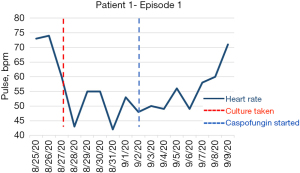 Figure 1 The heart rate trend during Episode 1 sepsis for the first patient. The red dotted line represents the date of blood culture sample collection and the blue dotted line represents the starting date of Caspofungin.
 - Caspofungin was started empirically on 09/02/2020 and continued based on culture sensitivity results.
- During this period, the patient’s heart rate dropped from the average of 75 bpm to below 45 bpm, with the lowest recorded at 42 bpm on 08/31/2020, despite vasopressor infusion. The heart rate gradually increased above 70 bpm within a few days after starting caspofungin.

Second episode
- As shown in Figure 2, blood culture was done on 03/07/2021 and reported as yeast in blood on 03/09/2021. It was identified as Candida auris infection on 03/11/2021.
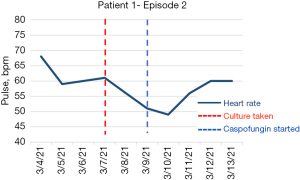 Figure 2 The heart rate trend during Episode 2 sepsis for the first patient. The red dotted line represents the date of blood culture sample collection and the blue dotted line represents the starting date of Caspofungin.
 - Caspofungin was started empirically on 03/09/2021 and continued based on culture sensitivity results.
- During this period, the patient’s heart rate dropped to less than 50 bpm, with the lowest recorded at 49 bpm on 03/10/2021, despite vasopressor infusion. The heart rate gradually increased back to 60 bpm within 48 hours after starting caspofungin.

Third episode
- As shown in Figure 3, blood culture was done on 05/20/2022 and reported as yeast in blood on 05/22/2022. It was notified as Candida auris infection on 05/24/2022.
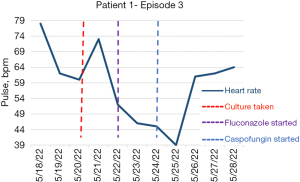 Figure 3 The heart rate trend during Episode 3 sepsis for the first patient. The red dotted line represents the date of blood culture sample collection, the purple dotted line represents the starting date of Fluconazole and the blue dotted line represents the starting date of Caspofungin.
 - Fluconazole was started empirically on 05/22/2022 and escalated to caspofungin based on culture sensitivity results on 05/24/2022.
- During this period, the patient’s heart rate dropped around 40 bpm, with the lowest recorded at 39 bpm on 05/25/2022, despite vasopressor infusion. The heart rate gradually increased back to average within 48 hours after starting caspofungin.

Case 2
The second patient was a 90-year-old male with a medical history of multiple comorbidities and limited cognitive and physical activities. In July 2022, he presented to the hospital with cardiopulmonary arrest. After successful resuscitation, he was admitted to the ICU for further management.
Throughout his 18-month hospital course, the patient experienced recurrent episodes of sepsis and septic shock with positive cultures (blood, urine, and respiratory).
As shown in Figure 4, a documented episode of fungemia on 12/06/2023. The presence of yeast in the blood was reported on 12/08/2023 and confirmed on 12/10/2023 as Candida parapsilosis infection. Caspofungin was initiated on 12/08/2023. Despite this, persistent positive fungal blood cultures with the same organism were detected on 12/14/2023, prompting escalation of antifungal therapy to anidulafungin and fluconazole.

During this period, the patient exhibited an unexplained bradycardia despite being on vasopressor infusion therapy. His heart rate dropped to less than 50 bpm, with the lowest recorded at 45 bpm on 12/06/2023. The heart rate gradually increased above 70 bpm within a few days after administration of the antifungal treatment.
Case 3
The third patient was a 34-year-old female with a medical history of Down’s syndrome, hypertension, diabetes mellitus, morbid obesity, obstructive sleep apnea, hypothyroidism, and a history of severe acute respiratory syndrome coronavirus 2 (SARS-CoV-2) infection.
In November 2023, the patient was diagnosed with viral pneumonia caused by respiratory syncytial virus (RSV), which had progressed to acute respiratory failure and septic shock. Consequently, she was mechanically ventilated and started on vasopressor infusion.
As shown in Figure 5, a documented episode of fungemia on 11/16/2023 was reported as yeast in blood on 11/18/2023 and was revealed on 11/21/2023 as Candida dubliniensis infection. Caspofungin was started empirically on 11/18/2023 and continued based on culture sensitivity results.

During this period, the patient experienced an unexplained bradycardia despite being on vasopressor infusion therapy. Due to persistent severe bradycardia, a dobutamine infusion was initiated. Her heart rate dropped from 110 bpm to less than 40 bpm, with the lowest recorded at 37 bpm on 11/11/2023. The heart rate gradually increased back to an average within a few days after starting caspofungin.
All procedures performed in this study were in accordance with the ethical standards of the institutional and/or national research committee(s) and with the Helsinki Declaration and its subsequent amendments. Publication of this case series was waived from patient consent according to the institutional Review Board of Dubai Health Authority.
Discussion
Fungemia has become an increasingly significant cause of morbidity and mortality in hospitalized patients. Several factors contribute to this trend, including the advancement of invasive diagnostic and therapeutic techniques since the beginning of the 21st century, prolonged hospital stays, excessive antibiotic use, and the rising number of chronically ill patients with compromised immune systems. These factors collectively have a direct impact on the increased prevalence of fungal infections (1,3,4).
The vast majority of invasive Candida infections are caused by five major species: C. albicans, C. parapsilosis, C. glabrata, C. krusei, and C. tropicalis (5). In the last few years, Candida auris had emerged as a new fungal threat as it is more resistant to the antifungal therapy (6).
However, nowadays the percentage of Candida non-albicans compared to Candida albicans fungal infection is rising due to their progressive ability to resist antifungal agents (4,7).
Correlation between fungal bloodstream infection and bradycardia was reported in few case reports. Despite being very rare, however, it was enough to be noticed (8-10).
A case report of a pediatric patient, He was diagnosed with a fungal bloodstream infection with Wickerhamomyces anomalus. He was treated with fluconazole and then escalated to amphotericin B. This case report highlighted the development of bradyarrhythmia as a severe complication, which ultimately contributed to the patient’s death (8).
A tertiary center study involved 14 patients with confirmed fungal infection and 14 normal persons as a control group. Serum samples were collected and introduced to isolated sinoatrial cells from guinea pigs in vitro. Then, the electrophysiologic activity of these sinoatrial nodes was monitored before and after exposure to the patients’ and control groups’ serum samples. Slowing of the sinoatrial nodes rate was detected in 78% of the cells exposed to the fungemia group serum (11 of 14 patients) compared to 7% only from the control group (1 of 14 patients) (11).
In an animal study designed to assess the physiological response to different pathogens, mice were divided into multiple groups, with each group receiving a large intraperitoneal injection containing a specific inoculum of pathogens. These pathogens included various bacterial species, such as Methicillin-resistant Staphylococcus aureus (MRSA) and Klebsiella pneumoniae, as well as Candida species. Notably, all the eight mice (100%) that were injected with Candida species developed significant bradycardia compared to 77% of the MRSA group and 66% of the Klebsiella pneumoniae group. The statistically significant finding was P<0.001 (12).
The results of this study demonstrated that bradyarrhythmia was a common response across the different pathogen groups, with the highest incidence observed in the group exposed to Candida species. This suggests that Candida pathogens may have a particularly strong association with the development of bradycardia in this animal model (12).
Several studies (13-15) highlighted the activation of cholinergic anti-inflammatory pathway as a response to endotoxins. In these studies, it was found that acetylcholine binds specifically to the nicotinic acetylcholine receptors, particularly the alpha7 subunit, located on the surface of various cells, including cardiac pacemaker cells. By binding to these receptors, acetylcholine induces a slowing of the heart rate, leading to bradycardia particularly in the context of sepsis conditions.
In this study, the coincidence of bradyarrhythmia with candidemia was recorded in three patients, data were systematically compiled and analysed. Bradycardia was specifically defined as a pulse rate falling below 60 beats per minute. Other potential causes of bradyarrhythmia were systematically excluded. Exclusion criteria included significant electrolyte disturbances, hypothermia, hypothyroidism, and the use of negative chronotropic medications (betablockers, digoxin and ivabradine). Also, a history of any similar attacks of bradycardia as a sign of structural or ischemic heart diseases. All these possible causes or history of bradycardia were excluded.
To strengthen our assumption of the link between bradycardia and fungal bloodstream infection in those patients. Patient 1 and patient 2, who had a long length of stay in ICU, had recurrent attacks of bacterial bloodstream infection with classic tachycardia and hypotension response. During these episodes of bacterial infection, no bradycardia was reported, similar to that during the fungal infection.
Data collection was extended over a continuous 24-hour period. To ensure the accuracy and reliability of the pulse rate measurements, the average of the three lowest recorded values was calculated. This approach was employed to minimize the potential impact of any isolated, coincidentally low pulse rate readings that might not be representative of the patient’s overall condition.
The analysis highlighted the critical importance of early recognition and timely intervention in managing bradycardia, as evidenced by the observed outcomes following the initiation of appropriate antifungal treatment.
A detailed analysis of three patients revealed significant variations: different genders, aged between 33 and 90 years, with hospital stays ranging from 6 weeks to 3 years. Their Candida infections had different sources and were caused by different pathogens: C. Auris, C. Parapsilosis, C. Dubliniensis. Despite these differences, they all experienced an unexplained bradycardia accompanied by septic shock. Fortunately, within a few days of starting antifungal therapy, all patients showed marked improvement.
Conclusions
In conclusion, the presence of unexplained bradycardia in patients suffering from sepsis and septic shock, though infrequent, represents a complex clinical puzzle, often indicative of an underlying fungal infection. The inherent delay in the growth of fungal cultures relative to bacterial cultures exacerbates this challenge, prolonging the time required for definitive diagnosis and initiation of targeted therapy, thereby potentially amplifying the risk of adverse patient outcomes, including heightened morbidity and mortality.
Before embarking on empirical antifungal treatment strategies, healthcare providers are tasked with conducting a thorough and multidimensional assessment, meticulously evaluating various clinical parameters. These include a detailed review of the patient’s medication history, assessment of the Candida score, consideration of the duration of hospitalization, meticulous analysis of antibiotic utilization patterns, evaluation of underlying comorbidities such as immune dysregulation and diabetes mellitus, and close monitoring of the patient’s response to ongoing antimicrobial therapy. Such comprehensive evaluations are indispensable in facilitating timely recognition and intervention in suspected cases of fungemia, thereby averting potential deleterious clinical outcomes.
This study serves to underscore the paramount importance of maintaining a high index of suspicion for fungal pathogens in septic patients presenting with bradycardia, advocating for heightened clinical vigilance and a proactive approach to diagnostic and therapeutic decision-making. Furthermore, it underscores the urgent imperative for robust clinical research endeavors aimed at elucidating the efficacy and therapeutic impact of early antifungal interventions on the broader spectrum of clinical outcomes in the context of sepsis. By advancing our understanding of these intricacies and refining therapeutic approaches, we can aspire to optimize patient care and enhance prognostic outcomes for individuals grappling with this formidable clinical entity.
Acknowledgments
None.
Footnote
Reporting Checklist: The authors have completed the AME Case Series reporting checklist. Available at https://acr.amegroups.com/article/view/10.21037/acr-25-9/rc
Peer Review File: Available at https://acr.amegroups.com/article/view/10.21037/acr-25-9/prf
Funding: None.
Conflicts of Interest: All authors have completed the ICMJE uniform disclosure form (available at https://acr.amegroups.com/article/view/10.21037/acr-25-9/coif). The authors have no conflicts of interest to declare.
Ethical Statement: The authors are accountable for all aspects of the work in ensuring that questions related to the accuracy or integrity of any part of the work are appropriately investigated and resolved. All procedures performed in this study were in accordance with the ethical standards of the institutional and/or national research committee(s) and with the Helsinki Declaration and its subsequent amendments. Publication of this case series was waived from patient consent according to the institutional Review Board of Dubai Health Authority.
Open Access Statement: This is an Open Access article distributed in accordance with the Creative Commons Attribution-NonCommercial-NoDerivs 4.0 International License (CC BY-NC-ND 4.0), which permits the non-commercial replication and distribution of the article with the strict proviso that no changes or edits are made and the original work is properly cited (including links to both the formal publication through the relevant DOI and the license). See: https://creativecommons.org/licenses/by-nc-nd/4.0/.
References
- Pandey N, Gupta MK, Paul P, et al. Necessity to identify candida species accurately with minimum inhibitory concentration determination in each case of bloodstream infections. J Infect Public Health 2020;13:753-8. [Crossref] [PubMed]
- Morrell M, Fraser VJ, Kollef MH. Delaying the empiric treatment of candida bloodstream infection until positive blood culture results are obtained: a potential risk factor for hospital mortality. Antimicrob Agents Chemother 2005;49:3640-5. [Crossref] [PubMed]
- Arastehfar A, Bakhtiari M, Daneshnia F, et al. First fungemia case due to environmental yeast Wickerhamomyces myanmarensis: detection by multiplex qPCR and antifungal susceptibility. Future Microbiol 2019;14:267-74. [Crossref] [PubMed]
- Almeida FA, Neves FF, Mora DJ, et al. Paracoccidioidomycosis in Brazilian Patients With and Without Human Immunodeficiency Virus Infection. Am J Trop Med Hyg 2017;96:368-72. [Crossref] [PubMed]
- Lockhart SR. Current Epidemiology of Candida Infection. Clin Microbiol Newsl 2014;36:131-6. [Crossref] [PubMed]
- CDC. Antibiotic Resistance Threats in the United States, 2019. Available online: https://ndc.services.cdc.gov/wp-content/uploads/Antibiotic-Resistance-Threats-in-the-United-States-2019.pdf
- Lockhart SR, Iqbal N, Cleveland AA, et al. Species identification and antifungal susceptibility testing of Candida bloodstream isolates from population-based surveillance studies in two U.S. cities from 2008 to 2011. J Clin Microbiol 2012;50:3435-42. [Crossref] [PubMed]
- Dutra VR, Silva LF, Oliveira ANM, et al. Fatal Case of Fungemia by Wickerhamomyces anomalus in a Pediatric Patient Diagnosed in a Teaching Hospital from Brazil. J Fungi (Basel) 2020;6:147. [Crossref] [PubMed]
- Samaddar A, Sharma A. First case of neonatal fungemia caused by Aureobasidium melanogenum. J Mycol Med 2023;33:101334. [Crossref] [PubMed]
- Aboutalebian S, Nikmanesh B, Mohammadpour M, et al. Candida palmioleophila candidemia and bacterial co-infection in a 3-month-old infant with biliary atresia. Front Cell Infect Microbiol 2023;13:1277607. [Crossref] [PubMed]
- Rosenfeld BA, Bosnjak ZJ, Shapiro RM, et al. Negative chronotropic factor in patients with fungemia. Crit Care Med 1992;20:327-31. [Crossref] [PubMed]
- Fairchild KD, Srinivasan V, Moorman JR, et al. Pathogen-induced heart rate changes associated with cholinergic nervous system activation. Am J Physiol Regul Integr Comp Physiol 2011;300:R330-9. [Crossref] [PubMed]
- Borovikova LV, Ivanova S, Zhang M, et al. Vagus nerve stimulation attenuates the systemic inflammatory response to endotoxin. Nature 2000;405:458-62. [Crossref] [PubMed]
- Wang H, Yu M, Ochani M, et al. Nicotinic acetylcholine receptor alpha7 subunit is an essential regulator of inflammation. Nature 2003;421:384-8. [Crossref] [PubMed]
- Tracey KJ. Physiology and immunology of the cholinergic antiinflammatory pathway. J Clin Invest 2007;117:289-96. [Crossref] [PubMed]
Cite this article as: Omar MA, Kewan H, Kandeel H, Makhlof M, Kotgire A, Ahmed S, Urooj S. Bradycardia in septic patients as an early sign of fungal bloodstream infection: a case series. AME Case Rep 2025;9:107.

